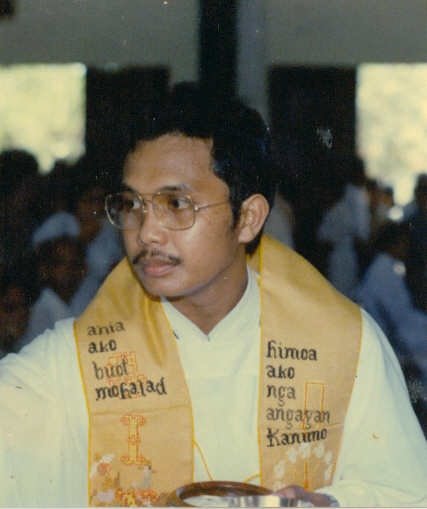
Sunday, April 29, 2007

Going up my mountain - Becoming an Occasional Hermit


Once again I am living the life of a hermit up in the mountain of Busay overlooking the city of Cebu.

I came up here six days ago and I will be here until May 23. Two years ago, I spent five months here, during my sabbatical. Now I can only spare a month.


This is my sacred space. I fell in love with this place when I was still a seminarian. I made a promise that I will come up here regularly (at least for a month) and spend time in solitude, silence and prayer. This is what I have been doing since my ordination - except for the six years that I was away for higher studies in Berkeley and in Rome.


This is a very relaxing time for me. Besides praying and meditating , I have enough time to jog along the trails and to practice Taichi. I set aside time for spiritual reading. I also do some writing (I am trying to finish my book projects). I cook my own meals and wash my clothes. Usually after supper, it is music time (playing the flute, violin or the guitar). When I am inspired, I compose some songs or write poetry.


Once a week, on Sundays, I go down to the monastery 12 kilometer below and have dinner with my confreres. This is also the time to check my e-mail, catch up on the news and get food supply.


Even though I live alone, I really don't feel lonely. I am in a flow, time goes so quickly. I feel re-energized. For now, I have to be contented with the little time I can spend here. When I reach 70, I would like to spend my remaining years here.


Friday, April 20, 2007

Consoling the mother of a Davao Death Squad (DDS) victim


I went over to Bangkerohan this evening to condole with Clarita - the mother of Fernando - and lead the prayer service which was held at the barangay hall. Fernando was only 15 years old. He had been warned by some Barangay officials that his name was on the list of the Death Squad. He was in hiding for several months but got homesick. A few days after returning home he was killed by the DDS. Three of his elder brothers were also executed by the DDS, several years ago. Clarita was inconsolable after losing her fourth son.

Life is so cheap in our country. They want to cleanse society of juvenile delinquents -without giving them a chance to reform. Meanwhile, the corrupt politicians, police and military men who have stolen millions and responsible for the suffering and death of so many of our people go unpunished.

Wednesday, April 18, 2007

Another victim of the Davao Death Squad (DDS)

I just received a message that Clarita Alia's teenage son, Fernando, was killed by the Davao Death Squad (DDS) yesterday. They stabbed him to death to make it appear that it was just another gangland killing. But Clarita insited that it was the handiwork of the DDS. Several months ago, Clarita was featured in the ITV-CNN documentary on the Davao Death Squads in Davao. She had already lost 3 sons to the DDS. And now she has lost her 4th son.

Over the last few months, the DDS have changed their tactics. Instead of shooting their targets, they now stab them. Thus, the killings are no longer reported in the media because they make it appear that these are the usual gangland killings. But their goal is still the same. To cleanse society of social misfits - petty thieves, drug addicts and pushers, etc. There are ove 500 victims of these summary executions. Many believe that the perpetrators are former communist-Sparrow Unit assassins and off-duty policement encouraged, supported or tolerated by the local government executive and the police. Even the US state department and the UN Rapporteur have expressed concern about these killings.

Elsewhere, the killings continue. In some areas the targets are petty criminals, in other areas the targets are members of alleged leftist legal organizations like Bayan Muna.

What is alarming is that in face of this culture of death, there is a culture of silence. This present government has not done anything to stop the killings. This government is in a state of denial, as the UN Rapporteur Allston reported. The ordinary citizens do not care. There is no public outcry. They keep on electing people who have blood on their hands.

We are just a few lonely voices, crying in the wilderness.

Monday, April 09, 2007

Celebrating Easter Among Poor Peasants

The other day I biked for 97 kilometers to a village up in the mountain of Talaingod to celebrate Easter with the members of the Basic Ecclesial Community (BEC). It took me over six hours to reach the place. The Redemptorist seminarians have been in the mission area for two weeks and they had invited me to preside at the Easter vigil celebration with the community composed mostly of poor peasants. After supper with the leader of the BEC, we begin the Easter vigil at 8 pm. The most powerful symbol of the liturgy was when the people accepted and shared the light from the paschal candal. In the midst of darkness, the candles the people were holding were bright enough to fill the the chapel. I reminded the people that the risen Christ - the light of the world - has conquered the darkness of sin and evil by his resurrection. We need to accept Jesus and live in the light. This requires dying to sin and living a new life - a life freed from sin and evil.

We finished the liturgy at almost 10 pm. After a light snack with the leaders, I went to sleep in the hut of the BEC leader. By 3:30 am, I was already awake. The people were ready by 4 am to celebrate the traditional "Sugat" - the ritual enactment of the encounter between the sorrowful mother Mary and the risen Jesus. It started with a procession - the men following the "risen Jesus" and the women following the "sorrowful mother." When the two processions met ouside the chapel, the angels took the veil of the sorrow mother, and her sorrow was turned into joy. The "Sugat" was followed by an Easter morning Mass which was over by 5:30 am. After breakfast, I biked for another six hours back to the parish.

Wednesday, April 04, 2007

Hearing Confession

I spent almost three hours listening to the confession of our church-goers after the mass this evening. Over 500 people turned up for the communal penitential celebration followed by individual confession. There were only 5 of us priests to hear the confessions of the people.

Well, I was not suprised by the big turn out. We are after all in the middle of the Holy Week and tomorrow is Holy Thursday.

Many of those who came to confess were people who had not been to confession for a long time. I was overwhelmed by the heavy and serious sins that they confessed. After almost three hours I was tired and I had a headache.

Many of those who confessed were in tears as they unburdened their guilt that they have been carrying for quite some time. I sensed that going to confession was an expression of conversion - the desire to change or renew their life. It was also the opportunity to communicate to them
God's mercy and compassion.

Friday, March 30, 2007

Fighting for Land

Last night, I celebrated the Eucharist with the people whose homes had been demolished. We had the mass in a temporary chapel amid the ruins of the houses that had been destroyed. Out of 140 families, 70 families remained and they live in makeshift home while the case is still being fought in the Court of Appeals. They have set up barricades, to prevent the demolition team from coming back. After the mass, we had agape. The people shared with one another the food that they brought.

For over 30 years, they have been occupying a piece of land owned by the government at the back of the Davao Medical Center. In spite of a memorandum of agreement, the director of the hospital wanted to drive them out and transfer to them to a distant relocation site. Half of the community resisted while the other half gave in. Those left behind were determined to fight for the land that they have be occupying for a long time. They are asking the government to include the land in the government urban housing program.

There are several Basic Ecclesial Communities in our parish that had successfully fought for their land. The first ones where in the Buhangin area several decades ago and the latest was in Spring Valley last year. These communities had to resort to both legal and extralegal means to defend their homes against the demolition teams. In the end the government acceded to their demands.

Saturday, March 24, 2007

Recovering from Cancer

I met Alice after mass this morning. She looked very well and felt well. She told me that she is recovering well from cancer. I cannot claim full credit for that but she told me I have been a big help.

Several months ago, she came to me feeling hopeless and helpless after being diagnosed with terminal cancer. She seemed like a woman who had just be handed the death sentence.

During our previous healing sessions I prayed over her and taught her a healing meditation to deal with the pain, visualize the cancer dissolving and visualize herself living up to 80 years old. I helped her go through the process of inner healing - dealing with the recent pain of feeling abandoned by her son which triggered the childhood pain of being abandoned by her mother. Being able to forgive her son and mother and letting go of the hurts and resentment contributed to the healing process. I also advised her to do the things she loved doing (she liked to sing) and to exercise. After a while the cancer stopped spreading and she decided to undergo surgery.

So it seems that she is not going to die yet and she may live up to 80.

Monday, March 12, 2007

Priestly Ministry and forming Basic Ecclesial Communities

I just got back from Catarman, Northern Samar where I conducted a seminar for the clergy. I had to travel by air, sea and land to get to that remote diocese. There were 45 priests in attendance together with Bishop Trance and Bishop-emeritus Hobayan.

Ten years ago, the diocesan pastoral assembly decided to adopt as a diocesan thrust the formation of Basic Ecclesial Communities (BECs) in all the parishes. As part of the tenth anniversary of the BEC program, I was invited to conduct a BEC re-orientation seminar to the clergy.

These were the topics that I presented during the three-day seminar:

1. The BECs: Phenomenological and Ecclesiological Perspectives
2. The priestly ministry vis-a-vis BECs
3. Building BECs: Pre-requesites and Strategic Framework
4. Evangelizing BECs
5. Organizing BECs
6. Mobilizing BECs for Social Transformation
7. Approaches to Building BECs
8. Developing a BEC culture

I emphasized that BECs are considered as new way of being Church. The BECs can be regarded as the Church at the grassroots, the Church in the neighborhood, the Church in the village. The vision of a renewed Church - a community of disciples where the members live in communion and participate in the mission of Christ as witnessing, worshipping and serving communities and as the Church of the Poor - may be experienced by the ordinary lay faithful in the BECs.

The priestly ministry must be understood and exercised in the context of the BECs. A new of being Church, requires a new way of being priests.
According to the Second Vatican Council and the Second Plenary Council of the Philippines, the ordained ministry cannot just be understood and exercised in cultic terms. Priesthood is not just saying mass or administering the sacraments. It also includes the pastoral ministry, the prophetic ministry, the social ministry.

As shepherds or pastors, the priests have the responsibility to gather and lead the flock - this means a ministry of forming a truly genuine Christian community and leading it. Since the parish is so big, this means forming a network of small Christian communities or BECs. Thus, the formation of BECs can be considered as a constitutive dimension of the priestly ministry.

Sunday, February 25, 2007

Celebrating EDSA People Power

Today, 22 years ago, the dictator, Ferdinand Marcos was ousted peacefully by hundreds of thousands of Filipinos that gathered at EDSA - the highway between Camp Aguinaldo and Fort Bonifacio. I was at that time in a distant barrio in Mindanao - hearing the good news on the radio. I had been grieving over my mother's death (she was killed by military men) and was wondering whether it was time to leave the priesthood and join the armed struggle against the government. The ouster of Marcos through non-violent means made the armed option unnecessary. Deep within, it affirmed my faith in the reality of God's liberating presence in the history of our people. Out of joy, I wrote this poem:

Psalm of EDSA

Ring the bells, blow your horns
light the fireworks, let the dance begin
in the barricades, streets, camps and homes.
Proclaim to the whole world the good news:
the dictator has finally fled to Hawaii!

This is the moment we have longed for
the moment of our deliverance!

They who put their trust in their armies
have been put to shame
by the multitudes of men, women and children
emboldened by the power of the cross
led by the frail widow of the man
who gave his life on the tarmac.

The instruments of terror
have unwittingly been converted
into forces for freedom
embraced and protected by the people.

The armalites, tanks and helicopters
were powerless against the risen people
ready to offer their bodies and blood without taking life
armed with their prayers, tears,
rosary beads, carved images of the Mother and Child,
crosses, flowers and food for the bewildered troops.

Let us praise and thank the Lord,
the God who is never blind, deaf nor powerless,
the subversive God
who has always been with us in our struggle
throughout the archipelago
who is present at EDSA
and who will accompany us on our journey
to the land of promise - a land flowing
with peace, justice and prosperity.

Let this moment be etched in our hearts
for we have shown to the world
the saving power of God!

______

Twenty-two years later, the euphoria is gone. It was a brief moment in our history when we were proud to be Filipinos. We thought that it would be followed by a transformed society. It was an Exodus, but we have not reached the promised land -- we are still wandering in the desert.

As I look at our society today, the situation has not radically changed. The dictator is long gone and dead. But the problems that plagued the people remain - widespread poverty, inequality, foreign domination of our economy, corruption in government and the military, the spiral of violence, extrajudicial killings, the culture of death, environmental degradation. Most of our politicians have the same attitude as the politicians during the time of Marcos -- greedy, corrupt, self-serving. Our president is no better than Marcos.

We have changed the political system , we have changed our leaders but we as a people have not undergone a process of conversion. The spirit of EDSA - of people power - seems to be gone. How long do we have to wander in the desert? When will we ever reach the promise land?

The desert is place of purification - a place of growing up as God's people. It is a place that we need to go through before we can enter the promise land.

Saturday, February 24, 2007

Christian-Muslim Dialogue of Life and Faith


This afternoon I attended a gathering of Muslims and Christians belonging to the Silsilah Dialogue movement. This is a group that come together occasionally to engage in an ongoing dialogue of life and faith. We prayed together, shared our faith and experiences and ended with a meal - table-fellowship.
I was impressed by the friendship and mutual respect among the members of the group. I liked the sharing of Ustadz Muhammad, a Muslim scholar and religious leader. He talked about Islam as religion of peace and how the terrorists misrepresent true Islam. He spoke about Jesus in a very reverent manner and the need for Christians and Muslims to live in harmony and peace. He seemed to be well versed not only with the Qur'an but also with the Bible.
I also shared my own conviction that Christians and Muslim have so many things in common in spite of differences. We believe in the one God, in Abraham as our father in faith, in Jesus the Son of Mary (Isa ibn Maryam) as the prophet (al Nabi) and the messiah (al Nabi) whose birth was announced by the Angel Gabriel (Jibril), who suffered on the cross, and ascended to heaven and who will come again in the last days. Jesus does not only belong to the Christians but also to the Muslims (although they do not believe in his divinity). Thus, Christians and Muslims are not just neighbors and friends, they are also "relatives."
I have been actively involved in Christian-Muslim dialogue for the last seven years. It started during the height of the armed conflict between the Government forces and the Moro Islamic Liberation Front. Together with Ustadz Mahmoud Adilao and Monsignor Jimmy Afable, we organized a Caravan for Peace across the war torn area. Over a thousand Christians and Muslims abourd trucks and buses journeyed towards Cotabato and set up a peace camp to pressure the negotiators to come to a peace agreement. During the journey for peace, we prayed together and shared meals together and established a bond among ourselves. Because of that Ustadz Adilao and his family became my close friends. Last year, I visited his home during the Eid Fitr and shared a meal with his family.
Another unforgetable moment was a visit I made to a mosque in Davao. I was accompanied by Sr. Marianella and Zuhaira. We entered the mosque during the midday Friday prayer and stayed at the back and prayed silently. The Imam - Eldio - invited me to speak to the Muslim worshippers after his sermon. I spoke for five minutes about our common religious heritage - the One God, Abraham, Jesus the Son of Mary - and how Christians and Muslims are should live in peace. Afterwards, we went to the home of the Imam for lunch - table-fellowship! Over the years, I have occasionally met the Imam during the various prayer rallies for peace in the city.
Zuhaira (or Pong) has become a very dear friend. She is a Muslim who is not only pretty but also intelligent and kind. We first met in Zamboanga six years ago during a Silsilah intensive seminar. I occasionally go out for dinner with her and Sr. Marianella. She told us that when she get married in a Muslim ceremony, Sr. Marianella and I will be one of the sponsors.
All these experiences have given me a positive regard for Muslims and for Islam. I firmly believe that Christians and Muslim can live in peace and work together for peace.

Sunday, February 18, 2007

Loving your Enemies: Ending the Spiral of Violence

"Love your enemies and do good to those who hate you... If anyone slaps you on the cheek, turn the other cheek as well." (Lk 6:27, 29)

Today's Gospel reading is one of the texts that I always found difficult to preach about in the past, especially during the dark days of the Marcos dictatorial rule.

I remember telling my novice-master 30 years ago that I could not accept this teaching. Two years earlier I had been released from prison after being tortured and imprisoned for seven months. I told my novice-master - "How can you expect me to love and forgive my torturers?" To do so would be to condone the abuses, the human rights violation, and the oppression under the dictatorial rule.

After my mother was robbed and killed twenty years ago by a gang composed of off-duty military men, it became even more difficult to accept this teaching. Love and forgive those who killed her? Anger and the desire for revenge filled my heart. I was just waiting for the results of the snap election called by Marcos before making a decision whether leave the priesthood and join the armed struggle. I remember asking for a sign from a God that I found difficult to believe in.

One month after my mother's death, I received the news that those who killed my mother were killed in an encounter with the police while robbing another house. There was divine justice after all.

Another month later - on February 21-25, 1986 - the most unbelievable event took place - millions of people massed at EDSA after a failed coup attempt and faced the troops, tanks and helicopters of the Marcos dictatorial regime. The people were ready die but not to kill. Many were kneeling and praying in front of the tanks. Some girls were giving flowers to the soldiers. Women were giving the soldiers food. A priest was embracing a soldier. This was the gospel in action - love your enemies! After four days, the dictator stepped down and fled to Hawaii. No blood was shed.

Two years later, I witnessed a similar event in San Fernando, Bukidnon. Our mission team had been organizing and mobilizing the Basic Ecclesial Communities to struggle against the logging companies that were denuding the forests and destroying the environment. The people barricaded the roads, so that no logging trucks could pass. They fed the drivers of the logging trucks and treated them as friends. One day, while celebrating the mass in the barricade, a platoon of soldiers came to break up the barricade. They began beating the people with their truncheons. But the people, did not move and allowed themselves to be beaten without putting up a resistance. They continued singing the Our Father, while crying. They did not harbor any hatred or ill feelings towards the soldiers. And when the soldiers drag the parish priest to bring him to prison, the people also climbed the trucks because they too wanted to be imprisoned. The soldiers gave up and released the priest. This was reported in the newspapers and TV, and the conscience of the new president (Cory Aquino) was moved and she suspended the licences of the logging companies. A year later, the people continued their struggle and demanded a total log ban using the same peaceful, non-violent means. Their demand was granted and Bukidon became the first province where a total log ban was declared by the government.

These two events made me appreciate Christ's teaching about loving our enemies and doing good to those who hate us. It does not mean tolerating evil or allowing injustice and oppression to continue. It means that in our struggle against evil, we are not driven by hatred or revenge but by love and compassion - for the enemies. It means being ready to suffer and die, but not to kill or make others suffer. It means not using evil means in our fight against evil. This requires ultimately forgiveness and reconciliation. This is that path of non-violence. This is the only way to end the spiral of violence. It only the power of love that can triumph over evil.

The great social transformations that have taken place in the 20th century were effected not by the use of force or arms, but by applying Christ's teaching of love and non-violent resistance. Mahatma Ghandi was inspired by the Sermon of the Mount and made it one of the inspiration of the non-violent struggle of the Indian people against the British Empire. Martin Luther King made use of it in the struggle for equal rights. Nelson Mandela and his movement succeeded in ending apartheid through non-violence. Communism in the Soviet Union and Eastern Europe also collapsed without bloodshed.

All of these followed the way of Jesus - the way of love and compassion, of peace and non-violence, the way of the cross.

Saturday, February 17, 2007

What's wrong with my heart?

I got the results of my medical check-up the other day and saw a cardiologist yesterday. I am still trying to come to grips with the bad news. High cholesterol level, high blood sugar level, high blood pressure, atherosclerotic aorta, ischemia at the inferolateral wall of the heart, and some problem with the liver. All of these add up to what is called syndrome X. In other words, the risk of a stroke or a heart attack is very high. I could drop dead anytime, like my father (he had diabetes and hypertension, and had a stroke and a fatal heart attack).

I thought that I was immune to heart disease since I have run marathons in the past and have been doing a lot of long-distance cycling. But a few months ago, while biking for over 4 hours across the steep mountain trails of Samal Island, I felt some chest pain. I had to stop and lie down. I was asking myself if I was having a heart attack. But the pain disappeared after 15 minutes. So I thought it was just the gas pain after drinking Coke. Looking back now, it appears that I had angina pectoris. There was not enough blood and oxygen getting to the heart because of the atherosclesis in the aorta and the ischemia.

I still have to do more tests this Monday (stress test, ultrasound, etc) to determine the gravity of my condition. I hope things are not as bad as it seems.

Meanwhile, I will have to watch my diet, exercise moderately, take some medication and supplements, learn to relax, avoid stress, etc.

I have become more aware of my mortality - I could die tomorrow or 50 years from now. I am not afraid of death, but I hope I live longer - there is still so much to be done.

Wednesday, February 14, 2007

Celebrating Valentine's Day - Alone

Here I am at Basti's Brew - my favorite coffee shop - enjoying my capuccino. I see lovers around me celebrating Valentine's Day.

I am all alone this time. The last time I was here was over two weeks ago - with Yna, Lucy and Kristine. We had just finished our farewell dinner for Yna in a nearby restaurant and crossed over here for our usual capuccino and dessert. This is where we usually meet regularly for the last 3 years to enjoy each other's company and talk about each other's problems, hopes and dreams. With Evelyn and Yna in their respective convents in Manila now, and in the absence of a quorum, we won't be able to hold our regular "meetings."

So meanwhile, I am enjoying my capuccino alone facing my computer, oblivious to the lovers around me. Strange, I don't really feel lonely.

"I am not really celebrating Valentine's "(I tell myself). This is a day for lovers, not for celibates like me.

It is best celebrated with someone very special -- with someone you really love deeply and with whom you really want to commit yourself to. I have given up that kind of love when I committed myself totally to God and his Kingdom. But I have not given up the capacity to love people - although it may be a different way of loving.

The vow of celibacy and chastity is vow to love God and people passionately -- with all my heart, my mind, my soul. This love is expressed in deeds of charity, service, compassion and care for people -especially the poor and needy. The Greek word for this kind of love is Agape. It is different from Eros.

It would be inappropriate for a celibate like me to be involved romatically and sexually with another person. Yes, I may have close friends but there are boundaries that I will never violate.
It is difficult but it has be done - I have to maintain a safe distance, especially from women I am attracted to. Here's a poem I wrote a long time ago.

Safe Distance

From a distance I gaze at you
safely,
painfully.

How I long
to touch you
and to be touched by you.

But I'm afraid
I might have amnesia.
I might forget
who and what I am
and the promises that I have made
to God.

I'm more afraid
that I might remember
that I am human
and I have needs
that cannot be ignored.

Forgive me
I cannot move any closer
to bridge this formidable gap.

You will remain
a distant figure
a face and a name
that will haunt my imagination.

What a fool I am
a fool for Christ's sake.

Sunday, February 11, 2007

Saying goodbye to a friend


I said goodbye to Yna this afternoon. She was leaving for Manila to start her formation as a postulant of the Cenacle Sisters.

Yna is a pretty young woman who had recently been promoted to a supervisory position in her office. She has been a reader in our Church for over 10 years and a member of the parish liturgy commission. We've been close friends for more than two years. We frequently go out together with 3 other friends for cappuccino and dessert after supper. We jokingly call the group the SFMD (Society of the Foot and Mouth Disease). No, it doesn't refer to the disease of animals. We just love to go places (foot) and talk (mouth). We talk about a lot of things - life in general and their hopes & dreams of the future.

Last summer, one of the members (Evelyn) decided to go back to her religious order which she left 10 years ago. And this afternoon, Yna left to pursue her religious vocation. I will miss them. Meanwhile, in the absence of a quorum, the SFMD is in recess until further notice (that is whenever, they come home for a visit).

I find it unbelievable that two of my dear friends would discover (or rediscover) their religious vocation. I don't take credit for that, although they tell me that our conversations over cappuccino have helped clarify the direction of their life. I was moved by Yna's note thanking me for my "words of encouragement, inspiration and challenge" and for "being a light at night time and a gentle breeze during the day" in her journey.

Yna reminds of a very dear friend I met when I was a newly ordained priest in Tacloban. Her name was Gina. She was a very beautiful young woman who read in our Church and a student in engineering. I was attracted to her but I was careful not to violate our boundaries and to maintain a celibate friendship. She later joined a contemplative order (Poor Clares) and we have maintained our friendship through the years although we do not see each other often.

With friends like them, celibate existence is less lonely and more bearable. It made me realize that friendship with women is not necessarily a threat to my religious vocation. It can be mutually enriching and can help us be faithful to our respective vocation and draw us closer to God. Celibacy does not mean giving up our capacity to love, it is a way of loving - chaste, non-possessive and non-exclusive. I never want to become a loveless, grumpy old celibate.

I thank God for the gift of friendship - for friends like Yna and Gina.
I like the way Italians say goodbye - arrividerci (Until we see each other again). We actually don't say goodbye to friends - we only say - til we meet again.

Saturday, February 10, 2007

Conducting a Clergy Retreat

I just came back from Cebu after conducting the annual retreat for the clergy of the Dipolog diocese, 52 priests and their bishop attended. The theme of the 4 day retreat was: "A Renewed Clergy for a Renewed Church."

The retreat was meant to enable the priests to review their life and ministry using as a framework a theology of ministry based on the Second Vatical Council and the Plenary Council of the Philippines. This framework emphasizes that ordained ministry has four dimensions: pastoral ministry, prophetic ministry, sacramental/liturgical ministry and social ministry. The retreat has 3 important components: 1)the presentations/talks given by me (the director), 2) the individual reflection/meditation, 3) the small group sharing (vicariate level and by peer group).


Day 1 Monday
arrival
6:30 pm - Dinner
8:00 - Opening Eucharist/Orientation

Day 2 Tuesday
7:00 am - Breakfast
8:15 Morning Prayer
8:30 Presentation 1: Pastoral Ministry (Ministry of Pastoral Leadership: Forming and Leading the Christian Community/ Basic Ecclesial Communities)
9:45 Individual Reflection/Meditation
11:00 Small group sharing (by vicariate)
12:00 lunch break
3:00 pm Presentation 2: Prophetic Ministry (Ministry of the Word: Forming and Leading a Prophetic, Evangelizing and Witnessing Community)
4:15 Individual Reflection/Meditation
5:30 Eucharist
6:30 Dinner
7:30 Holy Hour
8:30 Peer Group Gathering/Conversation (by age groupings)

Day 3 - Wednesday
7:00 am Breakfast
8:15 Morning Prayer
8:30 Presentation 3: Sacramental/Liturgical Ministry (Forming and Leading a Priestly/Worshipping Community)
9:45 Individual Reflection/Meditation
11:00 Small Group Sharing (vicariate level)
12:00 lunch break
3:00 Presentation 4: Social Ministry (Forming and Leading a Servant Community - that works for justice, peace and the integrity of creation, and for social trasformation)
4:15 Individual Reflection/Meditation
5:30 Eucharist
6:30 Dinner
7:30 Holy Hour
8:30 Peer Group Gathering/Conversation

Day 4: Thursday
7:00 Breakfast
8:15 Morning Prayer
8:30 Presentation 5: Celibacy and Ministry (Appreciating the Value of Celibacy and Living it More Meaningfully and Authentically)
10:00 Film Showing: The Crime of Padre Amaro
12:00 Lunch break
3:00 Presentation 6: Facing the Dark Side and the Responding to the call for to Ongoing Conversion.
4:30 Communal Penitential Celebration/Confession
5:30 Closing Eucharist
6:30 Dinner

Sunday, January 28, 2007

Celebrating Victory Against the Banana Plantations

After my morning mass, I biked to Wangan (a community up in the hills of Calinan, 35 km from Davao) to attend a victory/thanksgiving celebration of poor farmers who had been waging a campaign against aerial spraying in banana plantations. The participants of the celebration came from the neighboring barangays, the supporters and the NGO working with them (IDIS). Throughout the past nine months I have been supporting this campaign by joining in the Interfaith Prayer Rally in front of City Hall last June and the Vigil held in September. I have also gathered signatures from our own community, the parishioners and the members of the Basic Ecclesial Communities (BECs) in support of the Ban the Aerial Spraying.

Last week, the City Council finally passed the ordinance banning the Aerial Spraying in the whole of Davao, inspite of the lobbying made by banana plantation owners.

I am just amazed how poor people with the support of civil society and religious leaders were able to convince the city council to pass this ordinance. During the celebration, the people thanked God for the divine guidance and support.

This reminds of the anti-logging campaign in San Fernando Bukidnon 20 years ago carried out by poor people belonging to BECs which we supported. As a result of the people's non-violent struggle, a total log ban was imposed on the whole province.

Saturday, January 27, 2007

Lay Missionaries

I just got back from Iligan after conducting a missiology seminar in Iligan City for those undergoing training as Redemptorist lay missionaries. There are nine of them at present under the Alphonsian Lay Formation Institute. There are six male and three female trainees - most of them are in their mid-twenties. They are all college graduates - social work, agriculture, education, nursing. After their one-year training they will be assigned to the 4 Redemptorist mission teams in Visayas and Mindanao. At present there are over 30 lay missionaries working with Redemptorist priests and brothers. We depend on our lay missionaries to continue our missionary work as Redemptorists. I am amazed at their dedication and commitment. But we have to make sure that we provide them with adequate training and formation so that they will become competent and effective missionaries.

These are the topics I covered in four days of intensive seminar:
1. Mission ad Intra & ad Gentes
2. Trinitarian Foundation of Mission
3. Ecclesiological Foundation of Mission
4. The Goals and Paths of Mission
5. Dialogue and Mission
6. Mission and Inculturation
7. Evangelization - Proclamation and Witness
8. Building up the Local Church/Christian Community
9. Mission and Human Promotion & Development
10. Redemptorist Missions in Souther Philippines (Historical/Missiological Perspective)
11. Building Basic Ecclesial Communities (Missiological/Strategic Framework)

I am also teaching this course to Redemptorist major seminarians here at the St. Alphonsus' Theologate in Davao.

Sunday, January 14, 2007

Forming Basic Ecclesial Communities (BECs)

This morning I celebrated mass in Belisario Heights - an upper class subdivision/village. Around 150 residents came. Instead of preaching a brief homily after the gospel I gave a 40-minute powerpoint presentation about Basic Ecclesial Communities (BECs). Within the coming months I will be helping in the evangelizing and organizing process in this village. This is part of the efforts to form BECs in the upper class villages in the parish.

There are already 33 BECs in our parish. Most of these are found in lower class areas. There are some that are in middle class subdivisions. It is only recently that we have started the process of forming BECs in the upper class villages.

BECs are small communities of Catholic Christians whose members experience a sense of belonging and responsibility for one another. They are close to each other and share their resources with one another. They come together regularly to reflect on the Word of God. They also pray together and celebrate the Eucharist. They are not only concerned about spiritual matters - they also discuss the problems that they face (social, economic, political, environmental) and find ways to address these. They work for total human development, peace and justice. They live simply and are concerned about the poor and help empower the poor. The first Christian community in Jerusalem as recorded in Acts (2:42-47, 4:32-35) is the model of BECs. Communities like this are emerging all over the country and through these the vision of a renewed Church promoted by Vatican II and the second Plenary Council of the Philippines is becoming a reality. I wrote my doctoral dissertation on BECs at the Gregorian University (Rome) over a decade ago.

This afternoon I attended a meeting of the Parish Social Action Commission (PSAC). I am an adviser of this commission which is composed of lay people and has the task of monitoring the situation of the BECs and coordinating their efforts to respond to the social, economic and political situation of these communities. The commission has started doing environmental scanning and drawing up a SWOT analysis - part of the process of strategic planning.

Tuesday, January 09, 2007

Evangelical Poverty

Yesterday the Redemptorist community in Davao- composed of Redemptorist priests and seminarians - had a recollection day. We spent the whole day reflecting and sharing on the theme: "Evangelical Poverty."

As religious, one of the vows we have professed is the vow of poverty. For the last 30 years, I have tried to live this vow.

One the questions that I have tried to answer since the beginning of my religious life is how can we live the vow of evangelical poverty.

At the outset we need to clarify that evangelical poverty cannot be equated with material poverty or destitution. Material poverty is not a virtue in itself nor should it ever be glorified or romanticized. The majority of our people who are poor want to be liberated from poverty. It is a social problem that has to be eradicated if not minimized. it is part our our mission as Christians and as Religious to help improve the condition of the poor so that they will no longer live in poverty and will have a decent standard of living.

What then is the meaning of evangelical poverty?

It is first of all a matter of acknowledging our trust and dependence on God's loving providence. It is God and his kingdom that we treasure above all. We seek first the kingdom of God. All our energies are spent in the service of God's kingdom and not in the pursuit or accumulation of material wealth. It is God that we serve, not Mammon.

In carrying out our mission of proclaiming and building up God's kingdom, we embrace the condition of those to whom we are sent - especially the poor. It means accepting discomfort and even suffering. It means living simply. We cannot live in luxury amidst so much poverty.

This does not mean that we reject technology and the modern means of communication and transport. We need these to carry out our mission.

Evangelical poverty requires a spirit of detachment from our material goods and resources, and to share these with one another in our religious community and with the poor to whom we serve.

This means making an option for the poor, being in solidarity with them in their struggle to transform society.

Saturday, January 06, 2007

Welcoming the New Year 2007

I just got back the other day from my hometown in Iligan City where I spent my post-Christmas vacation and where I welcomed the New Year. Iligan is 385 kilometers from Davao across the mountains of Davao and Bukidnon. It took me two and a half days to cycle from here to Iligan and the same time coming back. I biked in the heat and in the rain. I used to do it in two days but this time I just took it easy. Besides I am not as strong and fast as I used to be. But at 52 years old, I can still do it.

What do I wish achieve during this year 2007?

I would like to finish writing my book on Ecclesiology entitled "The Vision of a Renewed Church" and have it published.
I would like to shape up, do more body-building exercises, and lose 25 pounds.
I would like to go around the country and give retreats, seminars and talks especially to the clergy and lay leaders.
I would to go scuba diving more often.

Saturday, December 23, 2006

Celebrating the Joy of Christmas amidst Adversities

Very early this morning, while it was still dark and cold, I celebrated the Misa de Gallo together with over three thousand parishioners/church-goers. Not all could be accomodated inside the church, others were contented to watch on a large screen the proceedings inside. The theme for this morning's mass was: "Working for justice - a concrete expression of loving God and Neighbor." Throughout the nine days of the novena-preparation, we have taken as the overall theme Benedict XVI's encyclical "Deus Caritas Est" (God is Love). So each morning our homilies touched on various aspects of this overall theme.

I am just amazed how we Filipinos can continue to celebrate the joy of Christmas amidst the adversities of life. Many of those who come to Church are not really well-off. There are many among them who come from the poor and depressed areas of our parish. Others may not be poor but they are suffering from illness, and some are going through grief and loneliness. Yet they fill the churches and celebrate with joy the birth of our Lord and Savior.

I myself know what it feels to celebrate Christmas amidst adversities. Around this time 33 years ago, a the early years of Martial Law, I found myself locked in prison with other political detainees waging a hunger strike to protest the maltreatment of our fellow prisoners. Around this time 21 years ago, our family was in grief as we buried our mother who was brutally killed by a gang composed of off-duty military men.

Now we celebrate Christmas in a situation no better than before. Majority of our people are poor. The spiral of violence and death continues to escalate - with the continuing insurgency war, the political killings, and summary executions. We have a president who, in order to hold on to power, has lied and cheated and violated the civil and human rights of people , and attempted to change the constitution. The darkness that reigns under martial law continues even under this supposedly democratic republic.

Celebrating in the dark as the new day dawns is a beautiful symbol of Christmas. We celebrate the coming of the light that will defeat the power of darkness.

Saturday, December 16, 2006

First Day of Misa de Gallo - Remembering my Mother


Today is the first day of the Misa de Gallo - Christmas is in the air! Amidst the joyful atmosphere, this day brings back sad memories. This was day the day my mother was killed 21 years ago - by a gang of holduppers whose members turned out to be military men.

To mark my mother's death anniversary, I went out for lunch in a Thai restaurant. I just imagined her presence while eating alone. I celebrated a memorial mass for her in the community chapel.

My mother, Nicole, would have been 80 years old today. She was just 59 when she was felled by a gunman's bullet after coming from the bank.

I wrote this poem during the wake:

Elegy for my Mother

My heart turned to stone
as I watched you gasped
for the last time
your eyes blank
and blood oozed from a hole
in your head made pointblank.
My eyes couldn't even shed a single tear.
Numb, numb, numb,
this was the only way
I could survive this madness.

What used to be
mere newsreports and statistics
have finally hit home.

"This is God's unscrutable will"
Some pious people consoled me.
"Praise the Lord!"

But I do not believe in a God
who can mastermind the murder
of a helpless mother.

What a blasphemy --
to make God the prime suspect
for the crime committed
by men who were supposed to maintain
peace and order.

This is the will of a rapacious regime
that has spawned an army
of thieves and murderers.

Mother,
I cannot imagine you now
as a mere pile of dust and bones
in a dark and lonely tomb.

I cannot regard you
as a mere memory.

Mother, I can neve believe
that a bullet could annihilate
everything that you have been
and will always be.

Thursday, November 30, 2006

Biking for Peace


For the last 5 five years I have been organizing a Bike for Peace annually during the Mindanao Week of Peace. This morning over two hundred cyclists turned for the Bike for Peace. I was worried that only around 70 cyclists would turn up since the president has moved the holiday tomorrow and today is a working day. I was pleasantly surprised to see the bigger number. Archbishop Valles and 12 cycling priests participated in the 34 km bike ride within the city. I also invited Joey Ayala who came all the way from Manila to give a mini-concert before the bike ride. Unfortunately, he could not bike with us since he had to leave immediately for Manila before lunch.

The Bike for Peace was preceded by a Walk for Peace which was participated by students, NGOs, and office workers. By 8:00 am, when the walkers reached Rizal Park, the opening ceremony of the Mindanao Week of Peace started. Archbishop Capalla and other Muslim religious leaders offered prayers. Then Joey Ayala gave a 20-minute concert. We were able to depart at 9:00 am. It took us more than two hours to ride through the busy streets of Davao and delived the message of peace.

Wednesday, November 22, 2006

Sick Call

I have been having this cold, cough and slight fever for over a week. So no biking and no workout until I get better. But life goes on - I continue to teach, say mass and hear confession. I can't afford to stay in bed. Alfonso, our seminarian who was a medical intern before joing the Redemptorist, gave me some medicine to soften the cough and prevent pneumonia.

This afternoon, while preparing my powerpoint presentation for my class in Ecclesiology, the parish secretary called me and asked if I could answer a sick call since there was no other priest available. I didn't want to do it since I was not feeling well. Nevertheless, I went to the home of the sick person whose name is Aida - a former leader of a Basic Ecclesial Community in the parish. She was very weak and had difficulty in breathing. She has been suffering from Parkinson's disease for over six years and she feared that she was going to die any time soon. I heard her confession and administered the sacrament of the anointing of the sick.

Aida told me that she sometimes feel as if God has abandoned her. After all the years of serving the Lord and her community, she ends up spending the last years of her life this way. As she was speaking, the rosary beads fell from her bed. I tried to console her. I told her that like Jesus, she is going through the sorrowful mystery of her life. She had her joyful mystery before that. The glorious mystery is still to come. No one is exempted from suffering and death. But we will not suffer for ever and ever. We should not fear death. After Good Friday, there will be an Easter Sunday.

After saying the final prayer, her tears were gone and she looked very peaceful. She told me that she is not sure if she will still be alive tomorrow. But she is ready to face God.

When I went back to the monastery, I felt glad that I answered that sick call even if I was not feeling well. This was the time when Aida was most in need of a priest.

Sunday, November 05, 2006

The Gift of Healing

Alice came this afternoon and asked me to heal her. She is a volunteer catechist in our parish and also one of the leaders of the Basic Ecclesial Community in a nearby barrio. She told me that she had been diagnosed with cancer in the ovaries and which has metastasized to the nearby organs. It is terminal (stage 4) - she was told. She doesn't want to be operated on, nor is she willing to submit to chemotherapy. She has accepted the possibility that she could die soon but she is still hoping for healing. That's why she came to me. So we started with an hour's session this afternoon and we will be meeting twice a week - until she gets well or die. The chance for a cure for those in the terminal stage is slim.

Besides praying over her, I tried to find out what has been happening to her through the years and what was causing her a lot of stress. I taught Alice a meditation technique that she can do twice a day. I also taught her the proper way of breathing. We also discussed physical exercise (walking) she needs to do and following a diet of vegetables, fruits, fish. I told her to avoid sugary and fatty food.

In dealing with cancer patients, there are three dimensions of healing that we should look at - physical (body), psychological (mind), and spiritual (soul). All these are connected and they influence each other. That is why healing must be holistic. The problem with standard cancer treatment is that it focuses only on the physical dimension and relies solely on drugs (chemotherapy), surgery and radiation theraphy. No wonder doctors are often frustrated because very few survive. Most cancer patients can extend their life to a few months or a couple of years. Nowadays, being diagnosed with cancer is like being handed the death sentence.

Instead of looking at a particular part of the body or an organ that is affected by cancer, it may be helpful to understand the person as whole - the joyful and sorrowful mystery of her life, the frustrations, anger, grief, alienation, shattered dreams, failed relationship, etc. It is important to know here story. The body is affected by the state of the mind and the soul. The physical disease could be a symptom for the need for inner healing. The healing of the mind and soul may lead to the healing of the body. But even if it does not lead to physical recovery, the inner healing itself can already be considered as an achievement. Death will no longer be seen as a defeat.

One of the interesting findings in studies conducted among patients is that stress caused by sense of loss, anger, guilt and anxiety can lower the body's defense system and contribute to the growth of cancerous tumors.

The healing of cancer patients can no longer be left just to medical practitioners - the doctors, nurses and drug companies. Psychologists, priests, spiritual healers and other practitioners of alternative medicine should also be involved.

During the early years of my priestly ministry I really did not believe in this kind of healing. I thought that this was the business of those in the medical profession. But there were times when I administered the sacrament of the anointing of the sick and prayed over patients that were seriously ill and given up by doctors. Many of them got well. So I adopted an open mind and began studying holistic/spiritual healing. I learned different methods of healing (pranic, reiki, etc.). When I was studying in Berkeley and in Rome, I became more involved in healing ministry. I have healed many people with all kind of diseases - including cancer. My friends jokingly said that I have a double doctorate - a doctor in theology and a quack doctor. But since I returned to the Philippines, I have not done a lot of healing because of my busy schedule - teaching, pastoral work, peace advocacy, conducting seminars, etc.

Thursday, November 02, 2006

Flowers, food and candles on the grave

Yesterday and today a lot of people all over the country went to the cemetery to remember their beloved dead. As usual they brought along with them flowers, food and candles. I am one of the few who didn't go to the cemetery. My parents and sister are buried in Iligan - that's almost 500 kilometers from Davao. So I didn't buy any flowers and candles but I went out for dinner alone in a Japanese restaurant to celebrate All Souls' Day. As I ate alone, I remember my loved ones who have gone ahead of me - my sister Nilda who drowned in 1967, my close friend Magno who drowned in 1979, my mother Nichol who was killed by military men in 1985, and my father Antonio who died of heart attack in 1993.

As we celebrate the feast of All Souls' there are some questions that people ask:
Why bring flowers to the grave? Can the dead smell their fragrance?
Why bring food? Can the dead eat?
Why light candles? Can the dead see these?

Flowers, food, candles on the grave - what do they signify?

Bringing flowers is an expresion of our love and affection for our dear departed. Death has not diminished our love for them.

Sharing food is an expression of the bond of fellowship, intimacy, and unity which death has not cut off. There is a continuing connection between the dead and we the living. That is why we pray for them and they pray for us.

The lighted candle symbolizes the risen Lord - Jesus Christ- who shines in the darkness of our grief. He is the source of our hope. He assures us that someday, we will be reunited with our loved ones in the home of our heavenly father - in the life to come.

Celebrating the Feast of All Souls therefore signifies that we have not forgotten our beloved ones who have gone ahead of us, we continue to love them, we affirm our continuing link with them and we express our faith and hope that the Risen Lord who is the light of the world will someday reunite all of us.

Friday, October 06, 2006

Celebrating the gift of life

I woke up early this morning and biked up the mountain of Busay. I came back to the Holy Family Retreat House by 7 am and after a quick shower and breakfast joined the priests and parish workers for morning prayer. After the prayer everyone started singing: happy birthday to you. I also received some text messages from friends and my sisters.
I am celebrating my 52nd birthday here in Cebu on the third day of our "colloquium" conference for Redemptorist priests and lay workers involved in parish, church and retreat ministry. I am one of the facilitators and organizers of this event.
Before noon, I walked to the nearby Redemptoristine monastery and had lunch with the nuns. I had actually invited myself when I met them after mass yesterday. They all kissed my cheek when I entered the convent. We had a videoke-singing session after lunch and I sang 4 songs including Moon River, Love Me Tender, Annie's Song and If. I went down later to Bo's coffee shop. While drinking my capuccino, I remembered the time when I was in a bar in Rome drinking cappucino alone on my 40th birthday and no one knew it was my birthday so I didn't receive any greeting or kiss - that was may loneliest birthday. I came back to the Retreat House in time for the evening mass. After dinner, I went out for pizza with the Davao Redemptorists and the parish staff.
I am looking forward to some belated birthday celebration with friends when I go back to Davao this Sunday.

I am full of gratitude for the gift of life that the Lord has given me, and for the gift of friends who remember me today.

Funny, I am 52 yet I really don't feel that old. The way I feel today, is the same way I felt 25 years ago. Maybe, I feel wiser but not older. I hope I will still be able to celebrate my 100th birthday.

Sunday, September 24, 2006

Celebrating 25 years of Priesthood


This evening the Redemptorist community in Davao celebrated the anniversary of ordination of 3 Redemptorists: Fr. Flan Daffy (50 years), Fr. Allen O'Brien (40 years) and yours truly (25 years). After a dinner of turkey, steamed fish and calamare, we had a program where the postulants and seminarians sang and danced. Each of the jubilarians were also asked to share their thoughts and reflections. I gave a powerpoint presentation of my life over the last 25 years - with photographs interspersed with poems. I ended my sharing with this poem:

Silver Jubilee
"those who die in the congregation will receive a crown of glory in heaven" - St. Alphonsus de Ligouri


Twenty-five years ago
when my hair was thick and wavy
and my tummy was flat and firm,
I stood before the altar
with no one by my side.
I made a promise to the Lord
to be a faithful priest
in the company of the sons of Alphonsus
for better or for worse, in sickness and in health
until I receive the crown he promised.

Twenty-five years later
with no hair on my head
and with an explanding waistline
I remain a faithful priest
in the company of the sons of Alponsus.
I kept my promise all these years.
I slept alone and loved the Lord and the people
with all my heart and soul.
I preached the good news of the kingdom
and worked for justice and peace.
I formed not my own family - but the family of God -
the Christian community.


Twenty-five years or more from now.
When not a single hair will grown on my head
and I look like a prisoner on death row,
when my tummy will be wider than my chest
when I can no longer bike
and a pretty nurse will push my wheelchair
I will remain a faithful priest
in the company of the sons of Alphonsus.
I will keep my promise
until I receive the crown he promised.

Thursday, September 21, 2006

PD 1081: Remembering Martial Law

I woke up early this morning to celebrate the six o'clock mass in the church. After the mass I went out to the lawn for taichi. Then I joined the community for the morning prayer. During the prayer of the faithful, one of the seminarians prayed for the victims of martial law. I became aware that I was one of those he was praying for today, the 34th anniversary of the declaration of martial law by President Ferdinand Marcos. The tattoo in my arm- a clenched fist in chains with the number 1081 - won't allow me to forget. PD 1081 - that's the presidential decree declaring the state of martial law.

Early in the morning thirty-three years ago, on the first anniversary of martial law, I was picked up by military agents in Cebu. I was interrogated and tortured for a week and imprisoned for seven months. The psalm that I wrote later sums up my experience and those of others:


Psalm from Prison

From this dark and lonely cell
I cry out to you
Lord, hear my groaning!

I don't know where I am
I don't know whether it's night or day.
I don't know what will happen next.

My throat is sore, I cannot scream anymore.
My finger is swollen, I cannot clench my fist.
My ribs are broke, I cannot stand erect.

I hate the sight of water I can no longer bear a single drop.
I loathe those cigarettes that penetrate my skin.
I dread the sound of foosteps and the opening of the door.
I prefer this darkness that face the glaring light.
I can just imagine what they are going to do next.

They said only I can end my suffering
if I cooperate with them
and sign the confession they manufactured
and bear false witness against myself
and those that oppose this diabolical regime.

How much longer, O Lord, can I hold on?
How much longer can I maintain my sanity?
How long will they keep me in this limbo?

Will I ever see again the sun?
Will I ever see again the faces of those I love and serve?
Or will they make me disappear forever?

Lord, deliver us from these kidnappers and murderers
who are trying to maintain peace and order.
Deliver us from these mercenaries
whose obsession is to defend national security --
the security of this bloodthirsty and power-hungry dictator,
the security of his cronies and their big business interests,
the security of his alien lords and their bases and investments.


O Lord my God.
I know that you are neither blind nor deaf.
Your mercy and compassion endures forever.
You have always been a subversive God.
You scatter the proud, you depose the mighty
your empty the rich, you lift up the lowly
you free the oppressed, you fill the hungry.

I cry out now to you:
subvert this evil kingdom and empire!
Let your spirit fill the hearts
of those who struggle to build your kingdom
of justice, peace and freedom.

From this dark and lonely cell
I cry out to you.
Lord hear my prayer.

Into your hands, O Lord
I commend my broken body
and my wavering spirit.


Late this afternoon as the sun was setting down, I joined the interfaith prayer service at the freedom park in front of Ateneo de Davao. It was just a small gathering. In my sharing, I told the crowd who were holding lighted candles that we should never forget that dark period in the history of our nation. Martial law may be gone but its legacy remains with us. The present Arroyo regime continues to abuse power, trample civil liberties and human rights, engage in corruption, and perpetuate the culture of death. Like martial law, those accused of being leftists or criminals are being executed by death squads. A policy of total war is being implemented by the likes of General Palparan who has been using the same methods reminiscent of martial law. The peace process between the government and the NDF has been abandoned. There is an escalation of war in the countryside.

NEVER AGAIN! This is what we said when the dictator was deposed by people power. Sadly, it is happening again, even without a declaration of martial law.

Monday, September 04, 2006

Growing Old - Reflections on the Third Age

There were five of us priests that spent the whole day at a cottage by the sea not to swim but to pray, reflect and share on our life and faith. This is what we call "Recollection" which we usually do on the first Monday of each month. There were two Irishmen - Allen and Aidan, and three Filipinos - Senen, Cruzito and myself. Allen is sixty-five years old, Aidan is fifty-five, Senen and myself are fifty-two, and Cruzito forty-five. We reflected and shared on the Superior General's Communicanda entitled - "Discovering the Best Wine at the End: Reflections on the Third Age." The Third Age is really Old Age.

My first reaction to this theme was -- it does not concern me at present. I am just turning fifty-two and old age is still far away. But the Superior General wants us to reflect on this as a community since there are elderly members among us and that we will all reach that age someday. The best time to prepare for the Third Age is when we are still in the Second Age -- during midlife.

I realize that I am growing old every day. Although I don't really feel old, there are a lot of reminders that I am indeed growing older. The most obvious sign is the loss of my thick and wavy hair. I decided to shave my head after all attempts at "reforestation" failed. I thought it was ridiculous to cover my head with the remaining hair on the side of my head.

Another sign is that I cannot run marathons anymore. My knees can no longer bear four hours of running on cement or asphalt pavement. So I have shifted to cycling. A time will come when I can no longer bike and instead ride a wheel chair. But that's still far away. Or is it?

I have to admit that I am past the noontime of my life. I am now in the afternoon and soon it will be evening. Two poems that I wrote sum up what I feel about the Third Age:


Sunset

As the sun sets beyond the sea
the old man limps along the shore.
The waves rush in to wipe away
the footprints on the sand.

It seemed like it was only this morning
that the sun emerged behind the mountain
and he was jogging along the beach.


Twilight

It's getting darker and darker.
What's happening to my eyes?
I can hardly move this ancient frame.

Where are they now?
Everyone seems to be gone.
I am all alone.

No wife.
No children.
No grandchildren.

Strangers visit me
and they call me father.
I cannot remember their faces
but they look familiar.
They take care of me.
They feed me.
They wipe my ass.

Whatever time I have left
is spent in looking back.
I am afraid to look forward -
there might be nothing there.

I wish my life was a vide-movie.
Then I can keep rewinding it
when the end comes.

I have so many, many yesterdays.
Is there a tomorrow beyond this final night?

I hope there is .
Otherwise, my self-oblation
would have been for nothing.

Time to say goodnight.
Time to sleep
peacefully, restfully.